Mechernich –
"It's five past twelve in healthcare" headlines the "Kölner Stadt-Anzeiger" and "Kölnische Rundschau" in their editions on Wednesday, 28 February. Editor Thorsten Wirtz reports on an "incendiary letter" written the day before by Norbert Arnold, Managing Director of the social welfare organisation Communio in Christo in Mechernich with 280 employees, to the health ministers Laumann and Lauterbach in Düsseldorf and Berlin.
The letter from Mechernich is part of a concerted campaign by the Verband Deutscher Alten- und Behindertenhilfe e. V. (VDAB), a nationwide organisation for private care companies. "For us, it's currently a matter of economic survival!" says the open letter from Norbert Arnold, which was also sent to local members of the federal and state parliaments and the media: "We're simply running out of money, it's already five past twelve!"
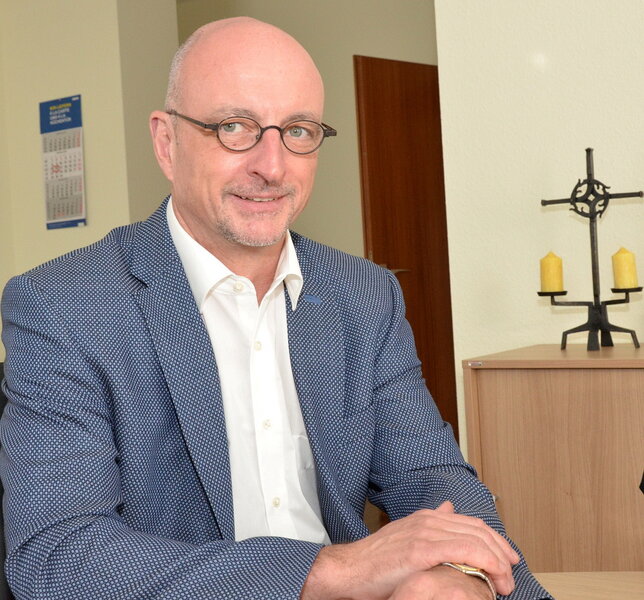
"The current situation in the care sector presents me and the company I manage with immense challenges," continues Norbert Arnold, who has managed the Ordo Communionis in Christo social organisation with care facilities in Mechernich (Communio in Christo long-term care) and Blankenheim (Haus Effata senior care facility) as well as the Stella Maris hospice in Mechernich for over 20 years.
At the same time, the 59-year-old lawyer does not want to worry the employees, writes Thorsten Wirtz: “We are a solid company that will definitely survive the current situation. As a non-profit organisation, we are allowed to accept donations, which of course helps us.”
But: "We are dependent on the care insurance funds and social welfare organisations granting us adequate prices in a timely manner and then receiving the payments on time." But that is precisely the problem: "Since the beginning of the year, we have been paying our care staff higher salaries and an inflation adjustment of 250 euros per month. But we are not yet being reimbursed for the higher rates."
"With our backs to the wall"
Every year on 1 November, the care facilities negotiate the new care rates with representatives of the health insurance companies and the regional association, Arnold said in the interview: "With a lot of luck, we will have a signed contract by the end of the year that regulates the new rates."
But the current situation is different: "It's now the end of February and we still haven't received any notification. It's outrageous," complains Arnold in an interview with the major Cologne daily newspapers, whose local editions are also published in the town of Mechernich and the district of Euskirchen: "We're running out of costs and missing out on revenue."
To speed up the process, Arnold is calling for a six-week deadline: "This should be more than enough time to confirm the new care rates. We need planning certainty!" While he still considers his company to be in a good position, he believes that the existence of many smaller homes is under threat: "What's more, not all places can be filled due to staff shortages."
Economically, many facilities in the sector have their backs to the wall. "The many reports of insolvencies in the care sector show that this is not a pipe dream, but a reality," emphasised the 59-year-old in the Kölnische Rundschau newspaper and the Kölner Stadt-Anzeiger newspaper.
If the bureaucratic procedures are not changed quickly, "the nationwide provision of professional care will no longer be guaranteed", Arnold's gloomy view is. The situation is exacerbated by the situation on the labour market. The joint training of nursing staff from geriatric, nursing and paediatric care, known as "generalist training", has also proved to be a disadvantage for geriatric care companies.
The Managing Director of the Communio in Christo social welfare organisation: "Many people who could have trained well as geriatric nurses, but who are unable to complete the generalist training, are now being lost to the care sector. This exacerbates a completely absurd competitive pressure on hospitals." The number of skilled nursing staff actually available in Germany is limited.
pp/Agentur ProfiPress